


Ready to supercharge your mission? Let's be honest, the world of nonprofit fundraising can feel like you're trying to fill a swimming pool with a teaspoon. Relying on the same old methods just won't cut it anymore. To truly thrive and maximize your impact, you need a modern playbook filled with proven, powerful strategies that deliver real results. This guide is your definitive resource, diving deep into the essential nonprofit fundraising best practices that successful organizations are using right now.
We're moving beyond generic advice to give you actionable, specific tactics. You'll learn how to build lasting donor relationships, tell stories that resonate deeply, and create unshakable financial stability for your cause. To truly unlock your organization's fundraising potential and move beyond conventional methods, explore these 9 Top Charity Fundraising Ideas for 2025 for fresh inspiration.
Whether you're a seasoned development director or a passionate volunteer leading a school sports team, these insights will equip you to not just meet your goals, but to smash them. One powerful way to show appreciation and boost campaign visibility is through custom branded merchandise, like personalized tumblers or awards from specialists like 4ULaserWorks. This guide provides the strategic framework to ensure your organization can continue its vital work for years to come. Let's get started
1. Build and Nurture Strong Donor Relationships
Forget transactional fundraising. The era of one-and-done donations is over. The real magic happens when you treat your donors less like ATMs and more like co-conspirators in your mission. This is one of the most crucial nonprofit fundraising best practices because it transforms fleeting support into a lifelong partnership, significantly boosting retention and lifetime value. It's about making your supporters feel seen, valued, and essential to your success.

Charity: Water excels at this by giving donors a portal to see the exact well their money helped build. This transparency fosters immense trust and connection. To effectively cultivate and retain your donor base, mastering customer relationship management basics is a foundational step, allowing you to track interactions and personalize your outreach.
Putting It Into Practice
Meaningful appreciation is a powerful tool. A local credit union supporting a youth sports team, for instance, could create custom-engraved powder-coated tumblers for top donors. Using a specialized, BBB Accredited service like 4ULaserWorks, which is also officially licensed with Creighton University and known for high-quality engraving, solidifies that community connection with a tangible, unique gift.
Actionable Tips:
- Speedy Thanks: Make thank-you calls within 48 hours for major gifts.
- Show the Impact: Send personalized impact reports within 30 days of a donation.
- Grant Access: Offer top supporters exclusive behind-the-scenes tours or briefings.
- Personalize Gifts: Move beyond generic thank-you notes. Consider creative, high-quality appreciation gifts that reflect your brand and the donor's commitment. Learn more about unique and personalized gift ideas on 4ulaserworks.com.
2. Tell Compelling Stories with Data-Driven Impact
Emotion sparks giving, but data closes the deal. The most effective fundraising narratives pair a powerful, human story with cold, hard facts that prove your organization's effectiveness. This is a core tenet of nonprofit fundraising best practices because it appeals to both the heart and the head. It shows potential supporters not only why they should care, but also what their contribution will concretely achieve, building a rock-solid case for support that is both compelling and credible.

DonorsChoose nails this by allowing donors to see the exact classroom project they funded, complete with photos and heartfelt thank-you notes from the teacher. Similarly, the American Red Cross effectively reports on disaster relief by sharing specific numbers on meals served, shelters provided, and aid distributed. This fusion of personal narrative and quantifiable results, popularized by experts like Tom Ahern, transforms abstract concepts into tangible, verifiable success stories that donors can feel proud to be a part of.
Putting It Into Practice
Translate your impact into relatable metrics. Instead of saying you "served 1,000 meals," say, "Your $50 donation fed a family of four for a week." This grounds your data in a human context. A corporate sponsor who funds a youth program can be shown not just participation numbers but also statistics on improved graduation rates, which you can then celebrate by presenting their team with custom-engraved corporate awards. Services like 4ULaserWorks, with their high-quality engraving on everything from awards to promotional gifts, help make that data-driven success feel tangible and celebratory.
Actionable Tips:
- One Story, Many Data Points: Focus on a single individual's journey (the "hero") and sprinkle in broader statistics to show the scale of your impact.
- The Donor as Hero: Frame your story so the donor is a key character who helps achieve the positive outcome.
- Create a Story Bank: Collect and categorize stories for different donor segments, ensuring you have compelling content ready for any campaign.
- Invest in Visuals: Professional photography and videography can elevate your stories and make the impact feel more immediate and real.
- Get Consent: Always obtain proper, written consent from the individuals whose stories and images you share.
3. Diversify Revenue Streams
Putting all your fundraising eggs in one basket is a recipe for an anxiety-fueled scramble. Relying on a single grant, one major donor, or an annual gala can leave your mission vulnerable to unexpected changes. This is why diversifying your revenue streams is one of the most vital nonprofit fundraising best practices for long-term stability and growth. It's about building a resilient financial foundation with multiple pillars of support.
Look at organizations like the YMCA, which masterfully blends membership fees, program revenue, individual donations, and grants. This multi-pronged approach ensures that a downturn in one area doesn't jeopardize the entire operation. By spreading the risk, you create a financial safety net that allows your organization to not just survive, but thrive.
Putting It Into Practice
A great way to branch out is through earned revenue from branded merchandise. For example, a school sports team can create a sustainable income stream by selling custom-engraved powder-coated tumblers to students, alumni, and fans. Working with a high-quality, BBB-accredited vendor like 4ULaserWorks ensures the merchandise is something supporters are proud to own, turning a simple purchase into a recurring revenue source and a powerful marketing tool.
Actionable Tips:
- Balance Your Portfolio: Aim for no single funding source to represent more than 50% of your total revenue.
- Start Small: Begin by adding one new revenue stream that aligns with your existing strengths and gradually expand.
- Track Your ROI: Monitor the cost-per-dollar-raised for each stream to identify what's most effective for your organization.
- Cross-Promote: Use your gala to launch a new merchandise line or promote your corporate partnership program in your grant proposals. Explore more ideas for unique promotional swag on 4ulaserworks.com.
4. Implement Strategic Donor Segmentation
Stop shouting the same message at everyone and expecting it to stick. Your first-time, $25 donor has different motivations than your ten-year, major-gift supporter. Strategic donor segmentation is the art of dividing your supporters into smaller, distinct groups based on shared characteristics. This is a game-changing nonprofit fundraising best practice because it allows you to tailor your communication, making every appeal feel personal, relevant, and far more effective.
The American Cancer Society, for instance, communicates differently with survivors, researchers, and family members, recognizing their unique connections to the cause. This targeted approach dramatically increases engagement and fundraising success by speaking directly to what matters most to each group. It’s about being a fundraising sniper, not a shotgun.
Putting It Into Practice
Start by identifying a few key groups within your database. A university might segment alumni by graduation year and giving capacity, while an environmental group could segment by interest in specific conservation projects like ocean plastics or deforestation. The goal is to move beyond generic appeals to create targeted campaigns that resonate deeply. For a sports team or school club, this could mean creating a segment for local business sponsors versus parent donors.
This infographic provides a quick reference for the three most common and effective ways to start segmenting your donor base.
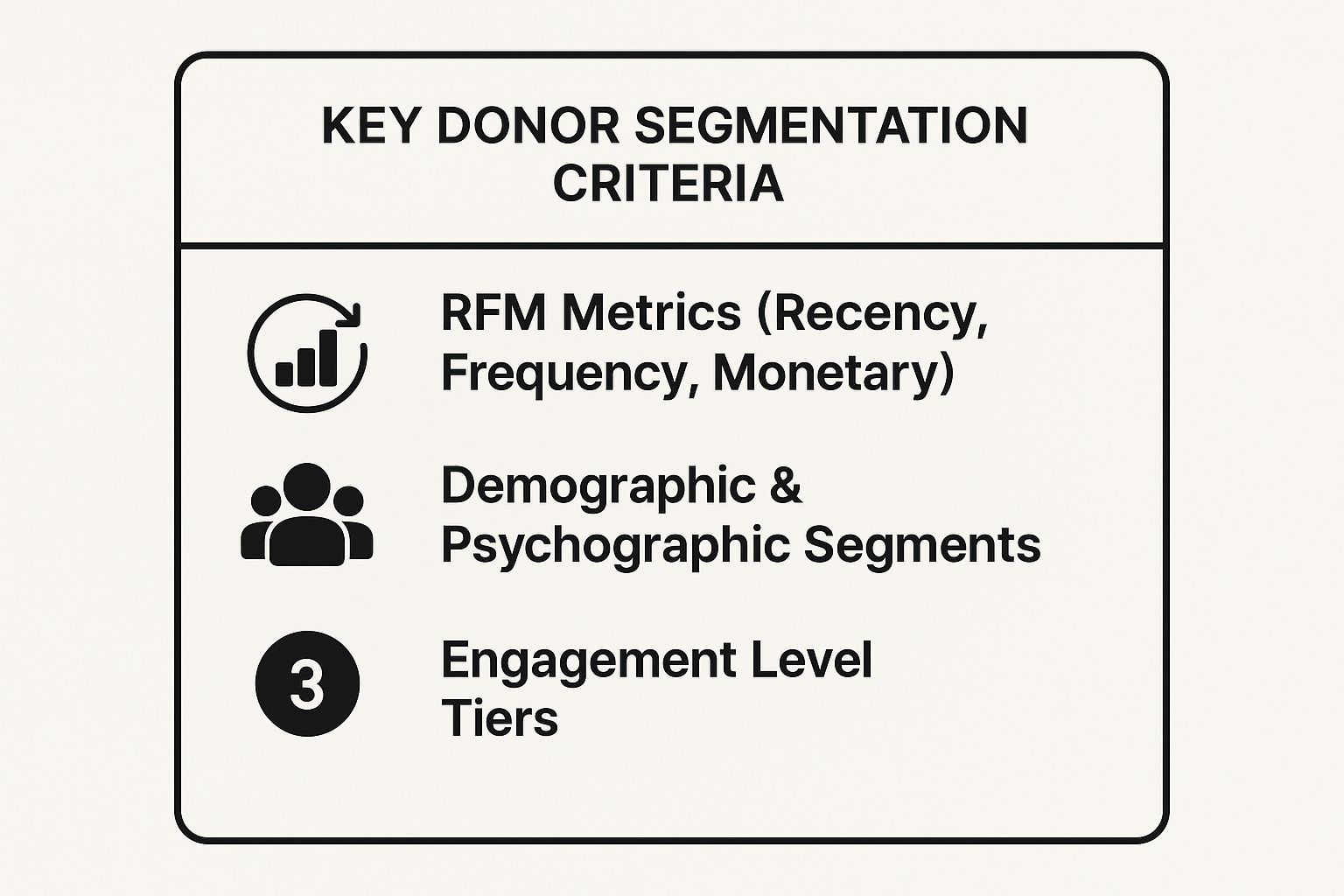
By combining RFM, demographic data, and engagement levels, you gain a powerful, multi-dimensional view of each supporter, allowing for highly precise targeting.
Actionable Tips:
- Start Simple: Begin with 3-5 key segments to avoid over-complexity. You can always add more later.
- Analyze Behavior: Use RFM analysis (Recency, Frequency, Monetary) to identify your most loyal and high-value donors.
- Test and Refine: Send different messages to each segment and track which ones perform best.
- Update Regularly: Donor behavior changes. Review and update your segment criteria at least once a year.
5. Leverage Technology and Automation
Stop trying to run your fundraising with sticky notes and spreadsheets. Manually managing every donation, email, and follow-up is a fast track to burnout and missed opportunities. Embracing technology isn't just for tech giants; it's one of the most impactful nonprofit fundraising best practices for scaling your mission efficiently. It allows you to automate repetitive tasks, gain deeper insights into donor behavior, and create a seamless giving experience for your supporters.
This means using digital tools to do the heavy lifting, freeing up your team to focus on what truly matters: building relationships and advancing your cause. From streamlined online giving platforms to automated thank-you sequences, technology empowers you to do more with less.
Putting It Into Practice
Technology shines brightest when it automates tasks without losing the human touch. An animal shelter, for example, can use a CRM to automatically send an adoption anniversary email with a donation link. Similarly, a school sports team can use an online store to sell custom-branded merchandise, automating the entire sales and fulfillment process. This creates a professional impression and a consistent revenue stream.
Actionable Tips:
- Start Simple: Begin with a basic CRM and an intuitive online donation platform. Don't try to implement everything at once.
- Go Mobile: Ensure your donation pages are fully mobile-responsive. A clunky mobile experience is a major donation killer.
- Automate, Then Personalize: Set up automated thank-you emails for immediate acknowledgment, but follow up with a personal call or handwritten note for larger gifts.
- Use Data for Good: Analyze your data to identify donors who are prime for a monthly giving pitch or a major gift ask.
- Brand Your Tech: Use technology to reinforce your brand. For instance, you can use a high-quality engraving service to add your logo to tech-related donor gifts. Find out more about the impact of laser logo engraving.
6. Focus on Monthly Giving Programs
Stop chasing one-off donations and start building a predictable revenue engine. A monthly giving program is your golden ticket to financial stability, turning small, manageable gifts into a tidal wave of sustained support. This is a cornerstone of modern nonprofit fundraising best practices because it offers donors an affordable way to make a huge annual impact while providing you with the reliable cash flow needed to plan for the future. You're not just getting a donation; you're gaining a committed partner.

Public radio stations have mastered this with their "sustaining member" programs, creating a loyal community of supporters who power their operations year-round. According to research from experts like Erica Waasdorp, monthly donors have significantly higher retention rates and lifetime value than one-time givers. The key is making them feel like insiders who are crucial to the mission's long-term success.
Putting It Into Practice
To make your monthly giving club feel exclusive, offer special perks that one-time donors don't receive. For a school sports club, this could mean creating a unique "Booster Club" tumbler for anyone who commits to a recurring gift. Partnering with a specialist like 4ULaserWorks, known for its high-quality engraving and personalized service to clients including banks, schools, and event planners, allows you to produce a premium, branded piece of drinkware that serves as a constant reminder of their valued support.
Actionable Tips:
- Set the Right Ask: Start your suggested monthly donation amounts in the $25-35 range to feel accessible yet impactful.
- Create Exclusivity: Offer monthly donors exclusive content, early access to event tickets, or special impact updates.
- Simplify Signup: Ensure the process is frictionless, ideally with one-click options on your donation page.
- Make It Easy: Allow supporters to easily pause, cancel, or modify their monthly gift without having to jump through hoops.
- Show Appreciation: Send a unique welcome gift to new monthly donors to solidify their commitment from day one. Explore ideas at 4ulaserworks.com for inspiration.
7. Engage and Activate Your Board in Fundraising
Your board members are more than just a governing body; they should be your ultimate fundraising MVPs. Tapping into their networks, passion, and expertise can supercharge your efforts and lend powerful credibility to your mission. This is one of the most impactful nonprofit fundraising best practices because it transforms passive oversight into active ambassadorship, unlocking doors to new donors and major gifts you couldn't access otherwise.
Think of it this way: your board members chose to dedicate their time to your cause. Their endorsement is a powerful signal to potential supporters. When a hospital foundation board member reaches out to their network for a capital campaign, it’s not just an ask; it's a personal testament to the organization's value from a respected community leader. This approach legitimizes your fundraising and expands your capacity exponentially.
Putting It Into Practice
The key is to equip and empower, not just demand. Start by setting clear, manageable fundraising expectations during the recruitment process. Provide them with a "fundraising toolkit" complete with talking points, email templates, and impact stories. A local credit union's board member, for instance, could leverage their professional connections by hosting a small, intimate "friend-raiser" event at their office, using high-quality branded promotional gifts as conversation starters. Discover how custom promotional swag on 4ulaserworks.com can equip your board with professional, mission-aligned materials.
Actionable Tips:
- Set Clear Expectations: Define board fundraising roles and goals during recruitment.
- Arm Your Ambassadors: Provide comprehensive training, scripts, and marketing collateral.
- Start in Comfort Zones: Encourage board members to begin by engaging friends, family, and close colleagues.
- Offer Diverse Roles: Not everyone is a solicitor. Offer roles like hosting events, making introductions, or writing thank-you notes.
- Celebrate Wins: Publicly acknowledge and celebrate every fundraising contribution made by board members to foster a culture of appreciation and healthy competition.
8. Create Compelling Campaigns with Clear Goals and Urgency
Vague, open-ended pleas for money get lost in the noise. Donors are inspired by specific, time-sensitive missions where they can see their contribution make a direct and immediate impact. This is one of the most effective nonprofit fundraising best practices because it channels donor energy toward a defined finish line, using psychological motivators like deadlines and matching gifts to combat procrastination. It's the difference between asking for money "for the kids" and asking for $50,000 by Friday to build a new playground.
The ALS Association's "Ice Bucket Challenge" is a legendary example. It had a clear, albeit quirky, call to action and a sense of urgency that made it go viral, raising an astonishing $115 million. Similarly, hurricane relief efforts succeed by highlighting the immediate, desperate need for funds, compelling people to act now. This focused approach transforms passive interest into active participation.
Putting It Into Practice
Clarity and urgency are your campaign's rocket fuel. A school sports team needing new uniforms for the upcoming season can launch a "Gear Up for Glory" campaign. The goal isn't just "raising funds"; it's raising a specific amount, say $5,000, before the first game. Offering a matching gift from a local business or setting a deadline creates a powerful incentive for supporters to donate immediately. Explore more on the best ways to raise money on 4ulaserworks.com to structure your campaign effectively.
Actionable Tips:
- Set SMART Goals: Ensure your campaign goals are Specific, Measurable, Achievable, Relevant, and Time-bound.
- Create Scarcity: Use countdown clocks on your donation page or offer limited-time matching gift opportunities.
- Tell a Focused Story: Frame your campaign around a single person, family, or project to make the goal concrete and relatable.
- Celebrate Milestones: Announce when you hit 25%, 50%, and 75% of your goal to build momentum and show progress.
9. Practice Transparent Financial Stewardship
Donors want to know their money is making a real difference, not just paying for fancy office chairs. Practicing transparent financial stewardship is about pulling back the curtain and showing supporters exactly how their contributions fuel your mission. This is one of the most powerful nonprofit fundraising best practices because it builds unshakable trust. When donors see you are a responsible and ethical steward of their investment, their confidence soars, leading to sustained and often increased support.
Organizations like GiveWell and Charity Navigator have built their entire models on this principle, providing deep-dive evaluations that donors rely on. They set a high bar, pushing nonprofits to be accountable. By proactively sharing financial data, from annual reports to breakdowns of program costs versus overhead, you control the narrative and prove your effectiveness, turning potential skepticism into committed belief in your work.
Putting It Into Practice
Demonstrating financial savvy isn't just about pie charts; it's about making smart, mission-aligned investments. For instance, when a credit union or school club hosts a fundraiser, choosing a high-quality, durable giveaway item like a personalized wood box over a cheap, disposable one shows respect for donor funds. Partnering with a reputable, BBB Accredited vendor like 4ULaserWorks for custom engraved items reflects a commitment to quality and longevity, ensuring the organization's brand and message endure long after the event, maximizing the initial investment.
Actionable Tips:
- Publish Reports: Make your annual report and audited financial statements easily accessible on your website.
- Explain Overhead: Proactively educate donors on why administrative and fundraising costs are essential investments for growth and impact.
- Aim for High Ratings: Use standards from services like Charity Navigator and GuideStar as a benchmark for your own financial health and transparency goals.
- Be Proactive: Use newsletters and social media to answer common financial questions before they're even asked, showing you have nothing to hide.
Nonprofit Fundraising Best Practices Comparison
| Strategy | Implementation Complexity 🔄 | Resource Requirements ⚡ | Expected Outcomes 📊 | Ideal Use Cases 💡 | Key Advantages ⭐ |
|---|---|---|---|---|---|
| Build and Nurture Strong Donor Relationships | High – requires personalized, ongoing engagement | High – time, staff, CRM systems | Increased donor retention and lifetime value | Long-term donor engagement, loyalty building | Stronger donor retention, predictable revenue, deeper engagement |
| Tell Compelling Stories with Data-Driven Impact | Medium to High – content creation & data collection | Medium to High – content production, data verification | Enhanced emotional connection and trust | Impact reporting, grant applications, marketing | Builds trust and appeal to diverse donors, multiple channels |
| Diversify Revenue Streams | High – managing multiple fundraising methods | High – expertise, administration | Financial stability and reduced dependency | Organizations needing risk mitigation and growth | Reduces financial risk, expands funding opportunities |
| Implement Strategic Donor Segmentation | Medium – data management and analysis | Medium – data systems, staff training | Higher campaign response rates, improved ROI | Targeted campaigns, personalized donor journeys | Efficient marketing, improved donor satisfaction |
| Leverage Technology and Automation | Medium to High – setup and integration | High – software, training, maintenance | Streamlined processes and scalable growth | Scaling operations, digital fundraising | Reduces admin work, improves donor insights, 24/7 processing |
| Focus on Monthly Giving Programs | Medium – program setup and stewardship | Medium – payment processing, communications | Predictable revenue and higher donor value | Organizations seeking sustainable cash flow | Predictable income, higher lifetime value, retention |
| Engage and Activate Your Board in Fundraising | Medium – training and coordination | Medium – training, ongoing support | Expanded network and credibility | Leveraging board influence for fundraising | Increased reach, credibility, higher-level prospects |
| Create Compelling Campaigns with Clear Goals and Urgency | High – strategic planning and execution | Medium to High – marketing resources | Focused fundraising with momentum | Time-bound, goal-oriented campaigns | Generates excitement, clear metrics, volunteer engagement |
| Practice Transparent Financial Stewardship | Medium – reporting and communication | Medium – financial systems, auditing | Increased trust and donor confidence | Building donor trust, grant applications | Builds trust, attracts efficiency-focused donors, accountability |
Putting Your Plan into Action for Maximum Impact
You've just navigated a treasure map of nonprofit fundraising best practices, from nurturing donor relationships to leveraging the full power of your board. It’s a lot to take in, but don't feel like you need to overhaul your entire strategy overnight. The secret to success isn't about doing everything at once; it's about doing one thing exceptionally well, then another, and another. Think of this guide not as a rigid rulebook, but as a buffet of powerful ideas. Pick the one or two strategies that resonate most with your organization's current needs and start there.
Is your donor communication feeling a bit stale? Double down on storytelling and strategic segmentation. Are you overly reliant on a single annual event? It's time to explore diversifying your revenue with a monthly giving program. The journey to a sustainable fundraising model is a marathon, not a sprint, and every small, intentional step builds powerful momentum. The most successful organizations understand that fundraising is less about transactions and more about building a thriving community around a shared mission.
Your Actionable Next Steps
Feeling inspired but not sure where to begin? Here’s a simple, three-step plan to get the ball rolling:
- Conduct a Mini-Audit: Gather your team and honestly assess your current fundraising efforts against the practices we've discussed. Where are your biggest strengths? Where are the most glaring opportunities for improvement? Maybe your donor data is a mess, or perhaps your board is passionate but unsure how to help. Identify your top priority.
- Set One SMART Goal: Choose one area to focus on for the next quarter. Don't just say, "we want to get more monthly donors." Instead, set a goal like, "Launch our 'Mission Keepers' monthly giving program by October 1st with a goal of enrolling 25 new donors at an average of $20/month." A specific, measurable, achievable, relevant, and time-bound goal provides clarity and a finish line.
- Create Tangible Touchpoints: As you implement these strategies, remember the power of genuine appreciation. The best nonprofit fundraising best practices are all rooted in making your supporters feel valued. A heartfelt thank-you call, a personalized impact report, or a high-quality token of gratitude can transform a one-time donor into a lifelong advocate.
Ultimately, mastering these concepts is about more than just hitting financial targets. It's about building a resilient, impactful organization that can weather any storm and continue serving its mission for years to come. By embracing authentic connection, data-driven storytelling, and unwavering transparency, you aren't just raising money; you're building a movement.
Ready to show your donors, board members, and corporate sponsors how much you value their support? 4ULaserWorks specializes in creating high-quality, custom-engraved corporate awards, personalized drinkware, and promotional gifts that make a lasting impression. Visit 4ULaserWorks to see how you can elevate your donor recognition strategy and turn appreciation into your most powerful fundraising tool.