


An event planning budget isn't just a spreadsheet; it's your financial command center. Think of it as the roadmap that organizes every projected expense and potential dollar of revenue into one cohesive plan. It transforms a jumbled mess of costs into a sharp, strategic tool that stops you from overspending, tracks where every penny goes, and ultimately helps you define what a successful event looks like.
Stop Guessing and Start Budgeting Like a Pro
Let's be honest. A blank spreadsheet staring back at you, titled "Event Budget," is where financial dreams go to die. It's an intimidating void that all too often leads to guesswork, mounting stress, and that frantic last-minute scramble to find more cash.
A solid event planning budget template is your secret weapon. It turns that chaos into a structured, predictable plan. This isn't just about plugging in numbers; it's about building a strategic framework that shields you from surprise fees and protects your bottom line.
This guide is all about helping you create a budget that's realistic, flexible, and as stress-free as possible. It’s designed to let you focus on what really matters—creating an unforgettable experience—not just figuring out how to pay for it.
The Most Common Budget Killers
Even the most meticulous planners can get tripped up by expenses that pop up out of nowhere. The biggest culprits? Almost always catering and technology.
In fact, wrestling with the budget remains a massive headache for event professionals. A staggering 40% name budget control as one of their primary challenges. A big reason for this is that costs are simply going up. 75% of planners have seen their food and beverage costs blow past their estimates, and 65% feel the squeeze from expensive A/V equipment.
These numbers scream one thing: a template is non-negotiable. It forces you to think through the nitty-gritty details that are so easy to forget.
- Sneaky Vendor Fees: Service charges, taxes, and gratuity can easily tack on an extra 20-30% to your final bill if you're not careful.
- Wildly Underestimated Catering: Food and drink costs can balloon in a heartbeat. For anyone in the industry, understanding the financial side of a guide on how to start a catering business shows just how deep these budgets need to go.
- Permits and Insurance: These are absolutely necessary but often forgotten until the last minute, leading to surprise costs you didn't plan for.
The purpose of a budget is to tell your money where to go, instead of wondering where it went. A great template is the tool that makes this possible, giving you complete control from day one.
A well-managed budget is the cornerstone of any successful event, especially for large-scale corporate functions. For a bird's-eye view of how this fits into the bigger picture, our guide on how to plan corporate events is a fantastic companion to the financial strategies we're covering here.
Core Components of an Effective Event Budget
Here’s a quick look at the non-negotiable categories every event budget template needs to keep your finances in check.
| Budget Category | What It Covers | Why It's Critical |
|---|---|---|
| Venue & Logistics | Rental fees, A/V equipment, staffing, security, permits. | These are often your largest fixed costs and the foundation of your event. |
| Food & Beverage | Catering per person, bar services, staff gratuity, taxes. | Can be highly variable and is a major area for potential overspending. |
| Marketing & Promotion | Advertising, social media, signage, printed materials. | This drives attendance and ticket sales—don't skimp here. |
| Speakers & Entertainment | Fees, travel, accommodation, special requirements. | High-profile talent can be a huge draw but comes with significant costs. |
| Contingency Fund | A reserve of 10-20% of the total budget. | Your safety net for unexpected costs, emergencies, and last-minute opportunities. |
Having these categories clearly defined from the start is what separates a controlled, successful event from a chaotic, budget-busting nightmare.
Let's Build This Thing: Your Budget Template, From Scratch

Alright, time to roll up our sleeves and turn that intimidatingly blank spreadsheet into your financial command center. Forget about clunky, expensive software. We're going to build a simple, powerful tool that gives you absolute control over your event's money.
The whole point is to create a living, breathing document—an event planning budget template that genuinely works for you. It needs to be clean, clear, and tell you where every single dollar is going at a moment's notice.
The Five Columns of Financial Clarity
First, let's lay the foundation. The real power of a good budget template comes from a few core columns that track your cash from hopeful guess to final payment.
Fire up a new spreadsheet and pop these headers into the first row:
- Category: These are your big-picture spending buckets. Think "Venue," "Catering," or "Marketing."
- Line Item: This is where you get specific. Under "Venue," you might have "Main Hall Rental" or "Security Deposit."
- Estimated Cost: Your best guess before signing any contracts. This is your starting line.
- Actual Cost: The real-world number. This column starts empty but becomes your source of truth as the invoices roll in.
- Variance: This one is the secret weapon. It instantly shows the difference between your estimate and the actual cost, highlighting every win and every overspend.
That's it. This simple five-column setup is all you need to get a crystal-clear, real-time view of your event's financial health. It’s the difference between a static to-do list and a dynamic financial tracker.
Let the Spreadsheet Do the Math
Now, let's make your life easier by adding a few simple formulas. No advanced spreadsheet wizardry required, I promise. We’ll start with that all-important 'Variance' column.
In the very first cell under your 'Variance' header (let’s pretend it’s cell E2), just type this formula: =C2-D2. It’s simply subtracting the 'Actual Cost' from your 'Estimated Cost'.
The result? A positive number means you saved money on that item (high-five!), while a negative number is a red flag showing you’ve gone over budget.
Now for the best part. Grab the fill handle—that tiny square in the bottom-right corner of the cell—and drag that formula all the way down your sheet. Boom. The spreadsheet automatically applies the logic to every single row, saving you from hours of manual math and potential mistakes.
A well-built template with a few smart formulas isn't just about tracking numbers. It's about getting instant financial feedback. This lets you make proactive decisions and pivot when needed, instead of cleaning up a budget disaster after the fact.
Taming the Chaos with Categories
With the skeleton in place, it's time to add the meat: your categories. Think of these as the main chapters in your event's financial story. Grouping your individual costs logically is what makes a budget easy to scan and understand, even when things get hectic.
Imagine you're planning a corporate conference. You could create a main category called "Guest Experience." Underneath that, you’d list line items like catering, the DJ, and maybe even some cool swag. For instance, budgeting for custom corporate awards or branded tumblers for attendees is a detail that can make a huge impact. Getting solid estimates means knowing your options; for some inspiration, check out this guide on where to get stuff engraved to find high-impact items that won't break the bank.
Here’s a quick look at how you might structure things:
| Category | Line Item |
|---|---|
| Venue | Main Hall Rental Fee |
| A/V Equipment Package | |
| Security Staff | |
| Marketing | Social Media Ads |
| Email Campaign Software | |
| Printed Flyers & Signage | |
| Guest Experience | Attendee Welcome Gifts |
| Keynote Speaker Fee |
This layered approach gives you the best of both worlds. You can see the big picture (how much you're spending on Marketing in total) and zoom in on the tiny details (what that social media campaign is really costing you). This is the kind of clarity that elevates a simple spreadsheet into your most indispensable planning tool.
Getting a Grip on Your Key Budget Categories
Let’s be honest, knowing what you need to spend money on is more than half the battle—it's the entire strategic heart of your event's financial plan. A good budget template isn't just a boring list of numbers; it's a roadmap that tells you exactly where every dollar is headed.
So, let's dive into the major expense categories you absolutely can't afford to overlook.
We’re going to dissect the "big three": Venue, Food & Beverage (F&B), and Audio/Visual (A/V). These are almost always the heavyweights that take the biggest bite out of your budget. Getting a handle on their quirks and hidden costs is what separates the seasoned pros from the planners who get knocked out by a surprise final invoice.
Imagine you’ve got a $100,000 budget for a corporate event. How do you even begin to slice that pie? While every event has its own unique flavor, industry averages give us a fantastic place to start.
This handy little chart gives you a quick visual on how a typical budget for a mid-sized event gets carved up.
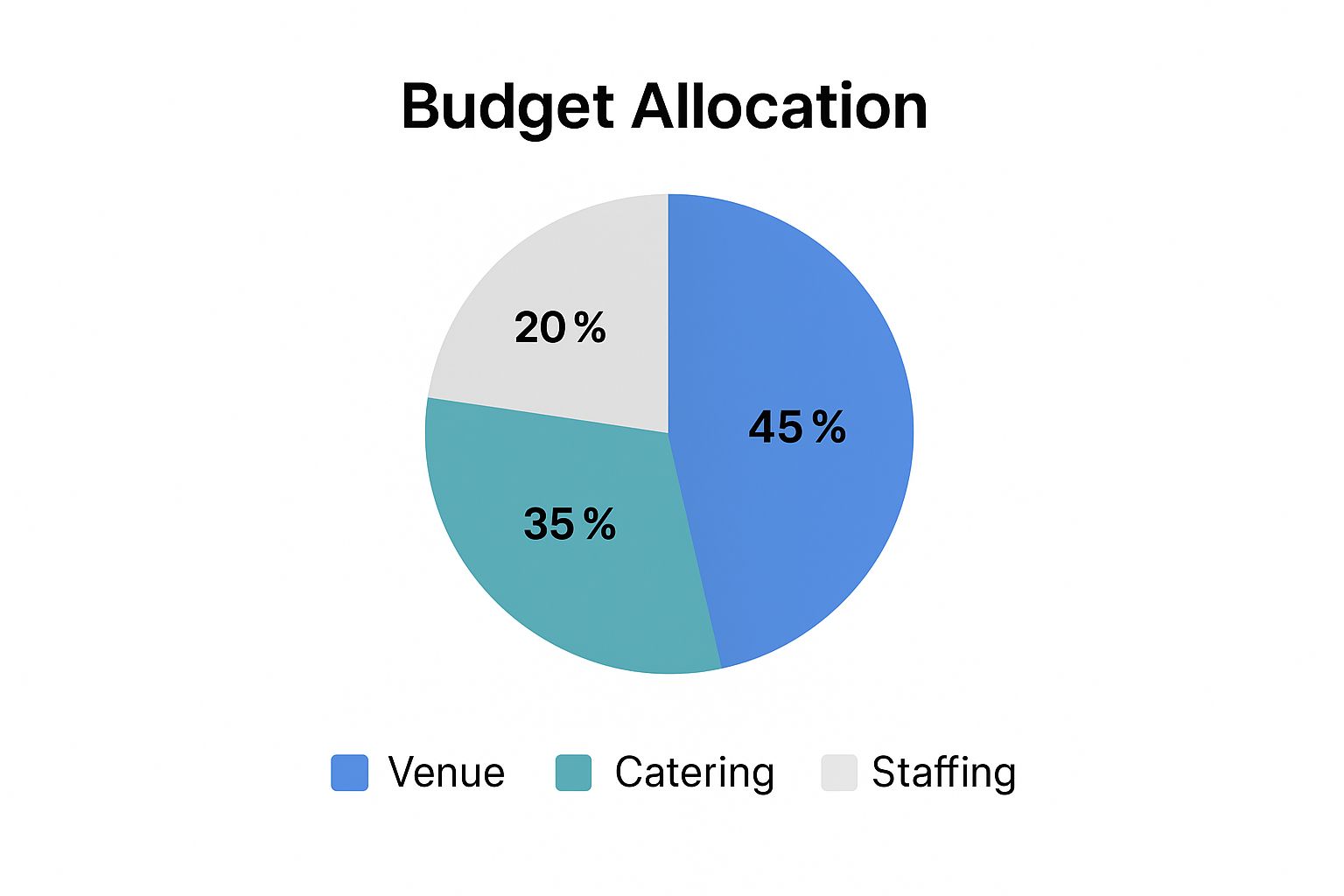
As you can see, the venue and the catering often eat up the lion's share. Nail these estimates early on, and you're already way ahead of the game.
To give you a clearer picture, here’s a sample breakdown of how a budget might look in the real world.
Sample Budget Allocation for a Mid-Sized Corporate Event
| Expense Category | Percentage of Budget | Example Cost ($100k Budget) | Key Line Items |
|---|---|---|---|
| Venue | 35% - 45% | $40,000 | Room rental, insurance, security, cleaning fees |
| Food & Beverage | 30% - 40% | $35,000 | Per-person meals, bar service, coffee breaks, taxes & gratuity |
| Audio/Visual (A/V) | 10% - 15% | $12,000 | Mics, screens, projectors, lighting, tech support |
| Marketing & Promo | 5% - 10% | $7,000 | Ads, social media, signage, printing |
| Swag & Gifting | 3% - 5% | $4,000 | Welcome gifts, speaker gifts, awards |
| Contingency | 5% - 10% | $2,000 | The "uh-oh" fund for unexpected costs |
This table is just a starting point, of course, but it illustrates how quickly the primary categories can consume your funds, leaving a smaller slice for everything else.
The Big Three Budget Line Items
Alright, let's get into the nitty-gritty of where that money is really going. These are the non-negotiables that demand a ton of attention in your template.
- Venue (35-45%): This is usually your single biggest line item. It’s not just the rental fee! Think about security deposits, mandatory insurance, cleaning fees, and any special permits you might need. My pro tip? Always, always ask for a complete cost breakdown before you sign anything. No surprises.
- Food & Beverage (30-40%): Ah, F&B—the notorious budget-buster. It's not just you; industry data shows that the average conference sinks nearly 29.9% of its budget into food and drinks alone. This is exactly why getting a precise headcount and understanding every single service charge and tax is so crucial. If you're a data nerd like me, you can get more great stats from GoGather's conference budget benchmarking report.
- Audio/Visual (10-15%): From simple microphones and projectors to complex lighting rigs and livestreaming setups, A/V costs can add up fast. Never skimp here. A professional attendee experience hinges on great sound and visuals.
Your budget template needs dedicated sections for each of these giants. Within each one, get granular. Under "Venue," don't just put "Rental Fee." Add lines for "Permits" and "Insurance" so they never slip through the cracks.
Don't Sweat the Small Stuff—Celebrate It!
Beyond the big three, a truly great event is all about the memorable details. This is where fun categories like "Marketing," "Entertainment," and "Swag & Gifting" get their moment to shine. These are the things that guests actually talk about later.
For corporate clients, credit unions, or even schools, handing out high-quality promotional gifts is a fantastic way to leave a lasting impression. When you're building your budget template, create a specific line item for "Promotional Gifts" or "Corporate Awards."
Doing this lets you strategically plan for items that provide genuine value instead of just being an afterthought. At 4ULaserWorks, we specialize in custom laser engraving on items like powder-coated tumblers and corporate awards that make attendees feel seen and appreciated. As a BBB-accredited and officially licensed Creighton University partner, we're known for high-quality engraving and personalized service for event planners. For some inspiration, check out some ideas for custom promotional swag in our dedicated guide.
By thoughtfully breaking down every single expense—from the ballroom rental down to the personalized drinkware—you turn your budget from a simple tracker into a powerful tool for crafting an unforgettable event.
Smart Ways to Manage and Reduce Event Costs
A great event budget template does more than just track where your money went; it's a crystal ball that helps you save money before you even spend it. With a solid plan in hand, you can spot opportunities to trim the fat without ever making your event feel cheap. This is all about being strategic, not stingy.
Let’s crack open the insider playbook for becoming a budget-savvy superhero. These are the practical, real-world tactics that separate the good planners from the great ones.
Master the Art of Negotiation
Your vendors are partners, not opponents. That said, you shouldn't just nod and accept the first price they slide across the table. Smart negotiation is about finding that sweet spot where everyone wins. Instead of just hammering them for a lower price, think about value-adds that can make a huge difference to your bottom line.
Here’s what you can try asking for:
- Waived Fees: See if they'll waive the corkage fee if you hit a certain bar minimum. Or maybe they can drop that cake-cutting fee. You don't know until you ask.
- Complimentary Upgrades: Can the venue throw in free Wi-Fi for all your attendees? Or maybe they can bump you up to the next A/V package at no extra charge.
- Flexible Payment Terms: Sometimes, cash flow is just as important as a discount. Ask if you can shift a payment deadline to better line up with your ticket sale revenue.
Timing Is Everything
Seriously. One of the simplest ways to slash a massive chunk from your budget is to be a little flexible with your event date. Every venue and vendor has a peak season and an off-season. Booking your conference on a Tuesday in January is almost guaranteed to be cheaper than a Saturday in June.
You have to think outside the box a bit. If a weekend is an absolute must, what about a Sunday brunch event instead of a Saturday night gala? The difference in venue and catering costs can be downright shocking.
Your contingency fund is the secret weapon against the unexpected. I always recommend setting aside 10-15% of the total budget as an 'uh-oh' buffer. A surprise cost then becomes a minor hiccup, not a full-blown crisis.
Embrace Technology to Boost Efficiency
Manual admin work is a silent budget killer. It just eats up hours of your time—time you could be spending on things that actually move the needle. A little investment in the right tech can save you a fortune compared to doing everything by hand. For example, exploring efficient check-in apps for events can cut down on staffing needs and make the whole entry process ridiculously smooth.
The same goes for marketing. Using email automation and social media scheduling tools can give you back hours of your week, freeing you up to focus on landing that big sponsor or negotiating better deals.
Find Strategic Partners and Sponsors
Newsflash: you don't have to foot the entire bill yourself. Go out and find sponsors whose brand makes sense for your audience. A local bank could sponsor the welcome reception, or a tech company might cover the Wi-Fi costs in exchange for putting their logo on the login page.
Sponsorships can completely offset some of your biggest line items. This can even extend to your giveaways. For memorable items that make a lasting impact without a huge price tag, check out our guide to impactful trade show giveaway ideas that sponsors are often more than happy to fund.
By weaving together smart negotiation, strategic timing, and the right partnerships, you can protect your budget and still deliver an incredible experience that feels anything but cheap.
Thinking Ahead: Future-Proofing Your Event Budget
If there’s one constant in the event world, it’s change. What works today might be old news by your next gig. That’s why a static, unchanging budget template is one of the quickest ways to fall behind. You need a financial blueprint that doesn't just track this year's costs but actually helps you anticipate what's coming next.
Think of your budget as a living document, not something you set and forget. It should evolve right alongside the industry. New tech, shifting attendee expectations, and surprise trends pop up constantly. A forward-thinking budget is your secret weapon for staying ahead of the curve and avoiding those last-minute financial scrambles.
This means getting proactive. Start building line items for trends that are clearly on the horizon. For example, are you ready to tackle the unique financial puzzle of a hybrid event, where you’re essentially funding two experiences at once? Have you thought about adding a category for sustainability initiatives, like carbon offsetting or sourcing from local, eco-friendly vendors? These aren't just trendy add-ons anymore; they're quickly becoming the standard.
Budgeting for Tomorrow's Tech
Technology is probably the biggest game-changer. From AI assistants that handle the grunt work to immersive VR experiences that wow attendees, the tools available to us are getting smarter by the minute. Setting aside a small slice of your budget to test-drive new tech isn't just "playing around"—it's a serious investment in your own efficiency and your event's success.
Get a head start by adding a few of these forward-thinking categories to your template:
- AI Planning Tools: Budget for subscriptions to platforms that can automate soul-crushing tasks like scheduling and data crunching.
- Virtual Experience Platforms: Earmark funds for the software that will be the backbone of your next hybrid event.
- Sustainability Tracking: Put money aside for tools or consultants who can help you measure and report on your event's environmental impact.
The global events industry is set to explode to an incredible $1.55 trillion by 2028. A huge chunk of that growth is coming from hybrid events and AI-powered planning. Planners who adapt their budgets to include these new costs and tech investments will be the ones who thrive. You can get a deeper dive into these event industry statistics and what they mean for planners.
A future-proof budget doesn't just react to change—it anticipates it. By building flexibility and room for innovation directly into your template, you transform it from a simple expense tracker into a strategic tool for growth.
This forward-thinking mindset also applies to your revenue streams. As events change, so do the opportunities to make money. If you're looking beyond ticket sales to fund your next big idea, our guide on the best ways to raise money is packed with creative strategies to build a rock-solid financial foundation.
Ultimately, this isn't just about planning the event in front of you. It's about cultivating a strategic financial outlook that keeps you ready for whatever the future throws your way.
Got Questions About Your Event Budget? We've Got Answers.

Still feeling a little shaky on the. Don't worry, you're in good company. Let’s tackle some of the most common questions that pop up when you're wrestling with an event budget. No fluff, just straight talk from the trenches to get you through the tricky spots.
So, How Big Should My Contingency Fund Really Be?
The industry gold standard is to set aside 10-15% of your total budget. Seriously, treat this as a non-negotiable line item. It's the difference between a minor hiccup and a full-blown crisis.
If you’re staring down a particularly complex event—say, a first-time outdoor festival where the weather is a huge gamble—you should absolutely lean closer to 15%, or even 20% if you’re feeling gutsy. Just remember, this isn’t your "oops, I forgot to budget for cool swag" fund. This money is exclusively for genuine emergencies, like a last-minute vendor price hike or needing to double your security staff overnight.
What's the Single Biggest Budget Mistake Planners Make?
Oh, this one’s easy. It’s underestimating the real cost of things. Planners get a quote for catering or A/V and plug that number in, completely forgetting about all the sneaky extras. We’re talking taxes, service fees, gratuities, and labor charges that can inflate your final bill by a staggering amount.
The other massive blunder is treating the budget like a static document. You can't just set it up and walk away. Your budget template has to be a living, breathing thing that you update in real time. The moment a contract is signed or an invoice is paid, that number goes into the spreadsheet.
An out-of-date budget is nothing more than a financial wish list. Real-time updates are what turn it into a powerful tool that keeps you in the driver's seat.
How Does This Template Help Me Prove Event ROI?
Think of your budget template as your secret weapon for proving ROI. When you’ve meticulously tracked every dollar, you can instantly calculate your cost-per-attendee and other critical metrics. This is the hard data you need to show stakeholders exactly what their investment achieved.
You can then compare that spending directly against your event goals. Did you generate leads? Boost brand awareness? Drive sales? A detailed budget connects the dots.
When you walk into that post-event meeting with a clean, organized report showing exactly where the money went, you demonstrate that you’re a responsible financial steward. It’s how you turn a conversation about cost into a conversation about value.
Ready to add those unforgettable, high-quality touches that make an event truly special? At 4ULaserWorks, we specialize in custom laser engraving for corporate awards, promotional gifts, and personalized drinkware that people will actually want to keep. As a BBB-accredited and officially licensed partner with Creighton University, we're the trusted choice for event planners, schools, and corporate clients who demand excellence. Explore our custom engraving options today!